
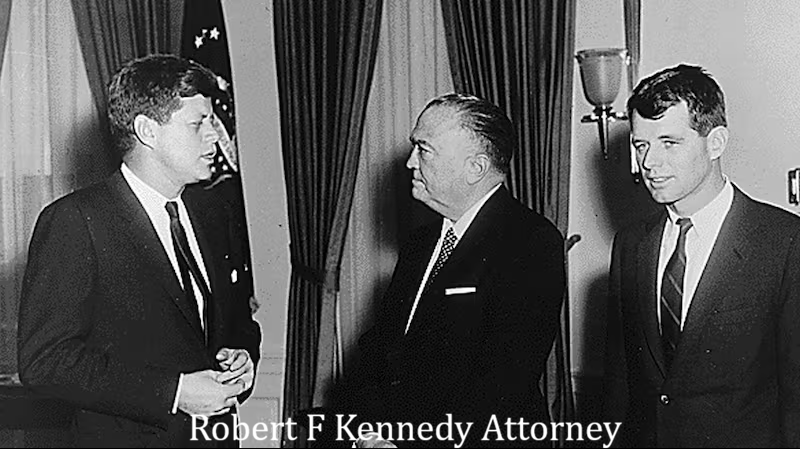
Robert f kennedy attorney People want to learn more than just the basics about him. They want to learn how Robert F. Kennedy used his training in law and leadership to combat crime, defend civil rights and help shape pivotal moments in American history.
- Early Life and Legal Education
- Building a Reputation in Public Service
- Appointment as Attorney General
- Fighting Organized Crime
- Championing Civil Rights
- Role During the Cuban Missile Crisis
- Commitment to Social Justice
- Why Robert F. Kennedy Still Matters Today
- The Lasting Legacy of Robert F. Kennedy
- Conclusion
- FAQs
- Q1. Who was Robert F. Kennedy?
- Q2. Why is Robert F. Kennedy important in American history?
- Q3. When did Robert F. Kennedy serve as attorney general?
- Q4. What role did Robert F. Kennedy play in the Civil Rights Movement?
- Q5. How did Robert F. Kennedy fight organised crime?
- Q6. What is Robert F. Kennedy’s legacy today?
Robert Francis Kennedy (or Bobby Kennedy), US Attorney General 1961-1964. Then he was one of the men at the head of the country. His work was more than law. He also discussed racial equality, voting rights, organized crime and national security.
This article looks at the life, work and legacy of robert f kennedy attorney and why he remains such a significant figure in American history.
Early Life and Legal Education
Robert was born in Brookline, Massachusetts on November 20, 1925, as the seventh of the eleven children born to Joseph P. Kennedy and Rose Kennedy. He was a seventh son of the celebrated Kennedys. Politics and public service were discussed in his family and that laid the groundwork for his future aspirations.
Kennedy, a Navy veteran of World War II, was a graduate of Harvard University, where he earned a degree in government. He received his law degree from the University of Virginia in 1951. His education was in law. His work ethic. His own values. His wish to help other people.
Building a Reputation in Public Service
Robert f kennedy attorney had held several government posts before becoming attorney general. He sat on Senate committees investigating major issues, and he made a national name for himself investigating corruption in labour unions.
One of his most famous investigations was of the Teamsters union. He investigated corruption in the ranks of labour boss Jimmy Hoffa. He was not afraid to take on the mighty and this was a reflection of his dedication to justice and fairness.
Robert F. Kennedy’s lawyer was a strong leader who believed that everyone should obey the law and all these experiences helped to build the reputation.
Appointment as Attorney General
Younger brother Robert was appointed attorney general by President John F. Kennedy in 1961. The appointment has been controversial, with some critics alleging that family links were involved. But Robert Kennedy soon proved himself equal to it in his leadership and industry.
He was attorney general and chief of the Justice Department, which oversees federal law enforcement nationwide. He wanted to make government work better, make the legal system better and solve big national problems.
Robert f kennedy attorney is remembered as one of those who made the office of the Attorney General a more powerful tool for justice and good change.
Fighting Organized Crime
Kennedy’s biggest achievement was his war on organised crime. Organised crime had taken over parts of the United States in the early 1960s.
He was in charge of the Justice Department’s push to speed up investigations and prosecutions of organized crime kingpins. In his time in office, convictions among criminals increased significantly. He kept on working. The big men didn’t like it. “No one is above the law,” he said.
Many historians have described the work of Robert F Kennedy attorney as some of his most significant victories over organized crime.
Championing Civil Rights
Early on Kennedy was very heavy on law enforcement. Over the years he became one of the federal government’s preeminent civil rights defenders.
In the early 1960s, African Americans were treated unfairly and discriminated against. Kennedy thought the civil rights movement required federal action. He fought for voting rights, for school integration and for equal access to public facilities.
In 1962 James Meredith became the first Black student to enroll at a university in Mississippi when he entered the University of Mississippi (Ole Miss). Federal marshals and troops were called in to help put him in school, as the court had ordered.
These deeds showed robert f kennedy attorney was willing to use the power of the federal government to advance constitutional rights and to fight racial discrimination.
Role During the Cuban Missile Crisis
Robert Kennedy’s impact reached beyond U.S. legal cases. The Cuban Missile Crisis of 1962, when the United States and the Soviet Union nearly went to war over Cuba. Robert was President Kennedy’s trusted advisor and helped the government to deal with the crisis.
He was heavily involved in the major negotiations. He was for a peaceful solution rather than military action . He also helped in the handling of Soviet officials during the tense situation. Many historians give him credit for helping to defuse tensions and avert nuclear war.
This chapter of the story is about a lawyer and key advisor in a dangerous moment in history. robert f kennedy attorney
Commitment to Social Justice
That was just a few months after the assassination of President John F. Kennedy and Robert Kennedy was a big deal. He later served as a U.S. senator from New York, taking on such issues as poverty, education, jobs and social justice.
Kennedy travelled to many cities and towns across the country. He travelled to poor neighbourhoods, Indian reservations and rural areas to learn more about people’s experiences. He thought leaders needed to get together face to face, not just read reports. The legacy of robert f kennedy attorney is his true desire to help people who are dealing with hard issues in their day to day life.
Why Robert F. Kennedy Still Matters Today
Robert f kennedy attorney is an inspiration to so many people around the world, even years after his death. He demonstrated that public leaders could exercise their power for the benefit of others and still be fair and kind. He always spoke of justice, equal opportunity and respect for people.
The issues he worked on civil rights and economic inequality are issues now. His speeches and actions are still being pored over by students, lawyers, historians and political leaders. His belief that ordinary people can make a difference still inspires many.
The Lasting Legacy of Robert F. Kennedy
Robert F. Kennedy was a man of courage of civic duty and commitment to justice. As attorney general, he fought for civil rights, fought organised crime and helped lead the nation through some major events. A senator who worked to improve the conditions of the less fortunate and promote peace.
Sadly, he was assassinated in 1968, but his legacy lives on through educational programs, human rights organisations and the many people inspired by his work. Attorney Robert F Kennedy His life is a great example of leadership, honesty and service to others For more info
Conclusion
Learning about robert f kennedy attorney is a good way to learn about one of the most influential leaders in the 20th century. His legacy as a crime fighter, public servant, civil rights activist and attorney general has left a deep imprint on American society.
Robert F. Kennedy believed the government should serve the people, do justice and give opportunity to all. He lived by using those ideas and his legacy evokes generations to date.
FAQs
Q1. Who was Robert F. Kennedy?
Robert F. Kennedy (1925–1968), American lawyer and politician. U.S. Attorney General, 1961-64; later U.S. Senator from New York.
Q2. Why is Robert F. Kennedy important in American history?
Fought organised crime, defended civil rights, helped people in need and played a major role in the Cuban Missile Crisis.
Q3. When did Robert F. Kennedy serve as attorney general?
Kennedy served as United States Attorney General from 1961 to 1964 under his brother, President John F. Kennedy.
Q4. What role did Robert F. Kennedy play in the Civil Rights Movement?
He fought for balloting rights, college integration and the same justice underneath the regulation. He supported federal civil rights protections.
Q5. How did Robert F. Kennedy fight organised crime?
As attorney general he increased the number of federal investigations and prosecutions of organised crime groups, leading to many more convictions.
Q6. What is Robert F. Kennedy’s legacy today?
He leaves a legacy of justice, equality, public service and human rights. Today, his work continues to inspire leaders, students and organizations around the world.


